
25 June 2026
Amazon US Prime Day 2026, Day 2: Discount Breadth Closes in on 2025 Levels
Following Day 1 of Prime Day, which saw a mix of less widespread discounting, but some big deals on Amazon US, a PMG analysis of tens of millions of products on Amazon US for Day 2 of the event shows how things can shift as the four-day event rolls along. The share of products running discounts on the site was only slightly off Day 2 2025 tallies, while the average discount rate also remained similar year-over-year (YoY).
As Prime Day continues, a key trend to watch will be whether more brands are holding off on discounts in the latter days of the sale. This, alongside any shifts in purchase activity, would signal a meaningful change in the dynamics of Prime Day from both the consumer and brand perspectives.
MethodologyDiscount data included in this analysis encompasses both Prime Day-specific deals and general promotional discounts observed by non-logged-in users across more than 30 million products on Amazon US on June 24, 2026. Prior year comparisons relate to July 9, 2025, and July 17, 2024, respectively.
Day 2 Discounting Activity Closes YoY Gap Compared to Day 1
After a Day 1 where discount depth remained steady, but breadth was notably down YoY, Day 2 was more in line with historical trends.
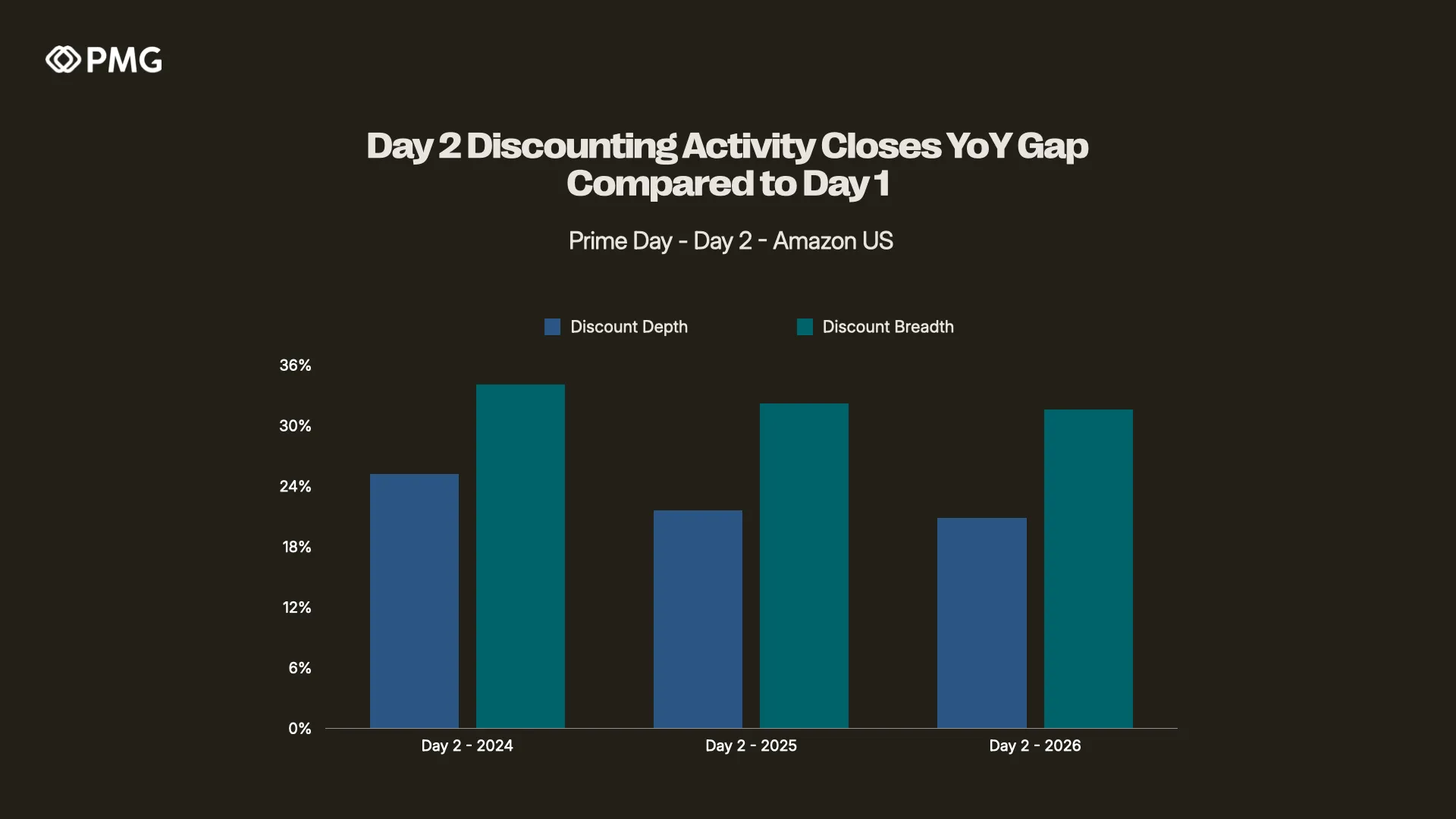
Discount depth held steady: The average discount rate on Day 2 came in at roughly 20.9%, essentially flat against the 21.6% observed on Day 2 of the 2025 event (a YoY change of about -3%, or roughly seven-tenths of a percentage point). For context, Day 2 of the 2024 event averaged 25.2%, so depth has eased meaningfully over the past two years but has nearly leveled off year over year.
Discount breadth fell meaningfully: The share of products carrying any discount came in at 31.6% on Day 2 of 2026, only narrowly below the 32.2% observed in 2025 and 34.1% in 2024, a decline of less than 2% YoY, or about half a percentage point. This marks a sharp contrast with Day 1, when breadth was down roughly 15% YoY, indicating that the Day 2 gap to last year's promotional reach has all but closed.
This dynamic suggests that, after a more conservative Day 1, more brands brought their promotions online on Day 2, lifting breadth back in line with last year, even as headline discount depth held steady. It is a pattern worth watching against Amazon's stricter rules on discount-tagging qualifications during Prime Day, as referenced in yesterday’s readout. For shoppers, this trend could portend a higher relative degree of deal availability in the coming days.
More Discounts Continue to Concentrate Below 20% Off Compared to Prior Years
Similar to Day 1, the distribution of discount offers by depth shows how shallower price cuts command an increasing share of all discounts offered on the site.
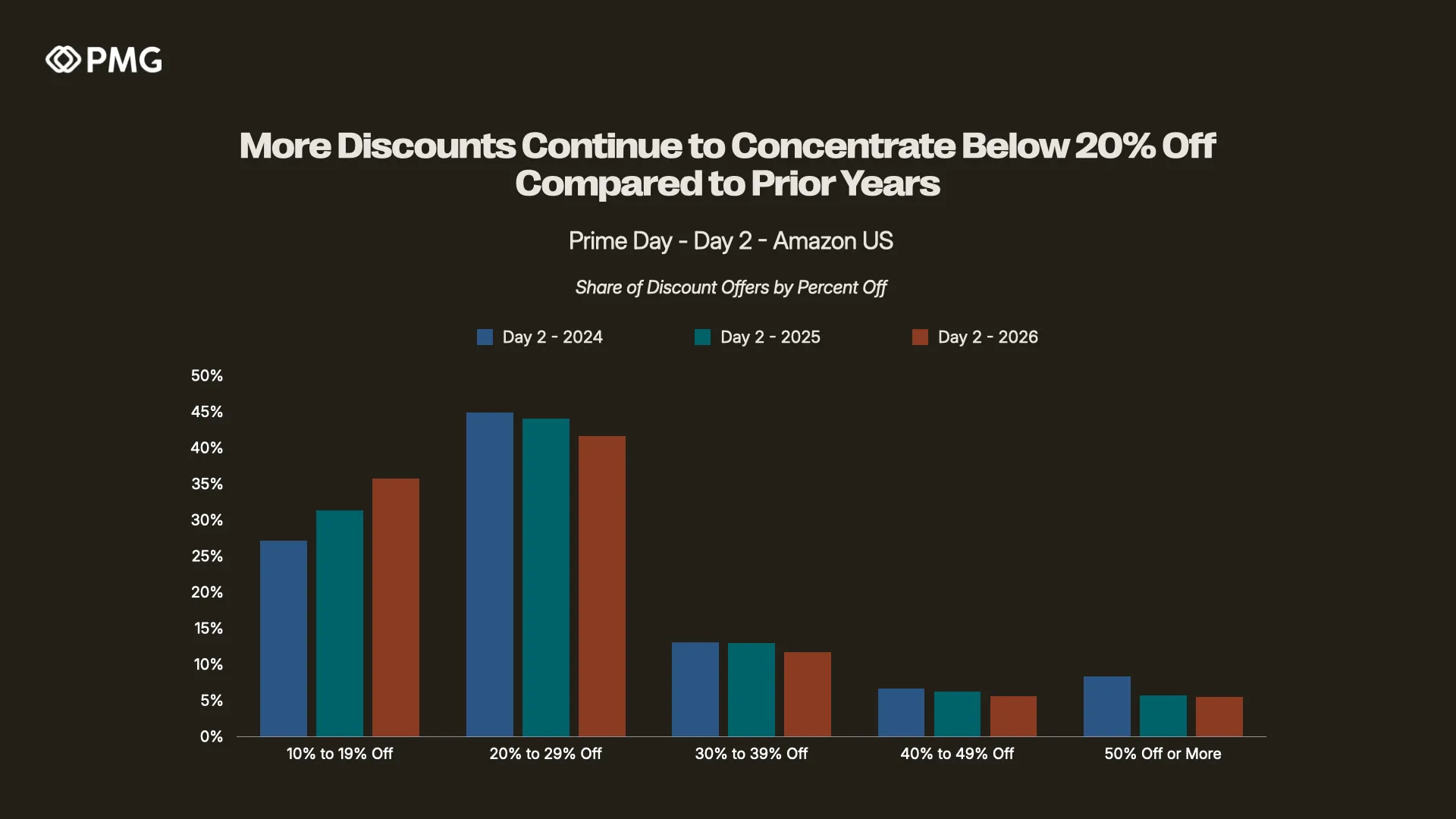
The share of discount offers in the 10% to 19% off band rose to 35.7% on Day 2 of 2026, up from 31.3% in 2025 and 27.1% in 2024, mirroring the multi-year climb observed for Day 1.
At the other end of the spectrum, 50% off or more offers now make up just 5.5% of discounts, still well off the 8.3% observed on Day 2 in 2024 but similar to 2025's 5.7%.
The 20% to 29% off band, which has been the largest group in prior years, dropped to 41.6% from 44.0% in 2025, while the 30%-39% and 40%-49% bands eased to roughly 11.7% and 5.6%, respectively.
This again points to the ‘typical’ Prime Day deal getting shallower over time, with a greater share of 2026 Prime Day offers settling in the 10%-19% range. While bigger deals still abound, they aren’t as common across the US site during the sale event as in prior years.
Categories Grow Less Differentiated by Discount Depth & Breadth
Looking beyond whole-site averages, comparing discount depth and breadth across top-level categories in 2024, 2025, and 2026 indicates that discounting behavior is becoming more consistent across Amazon US over Prime Day.
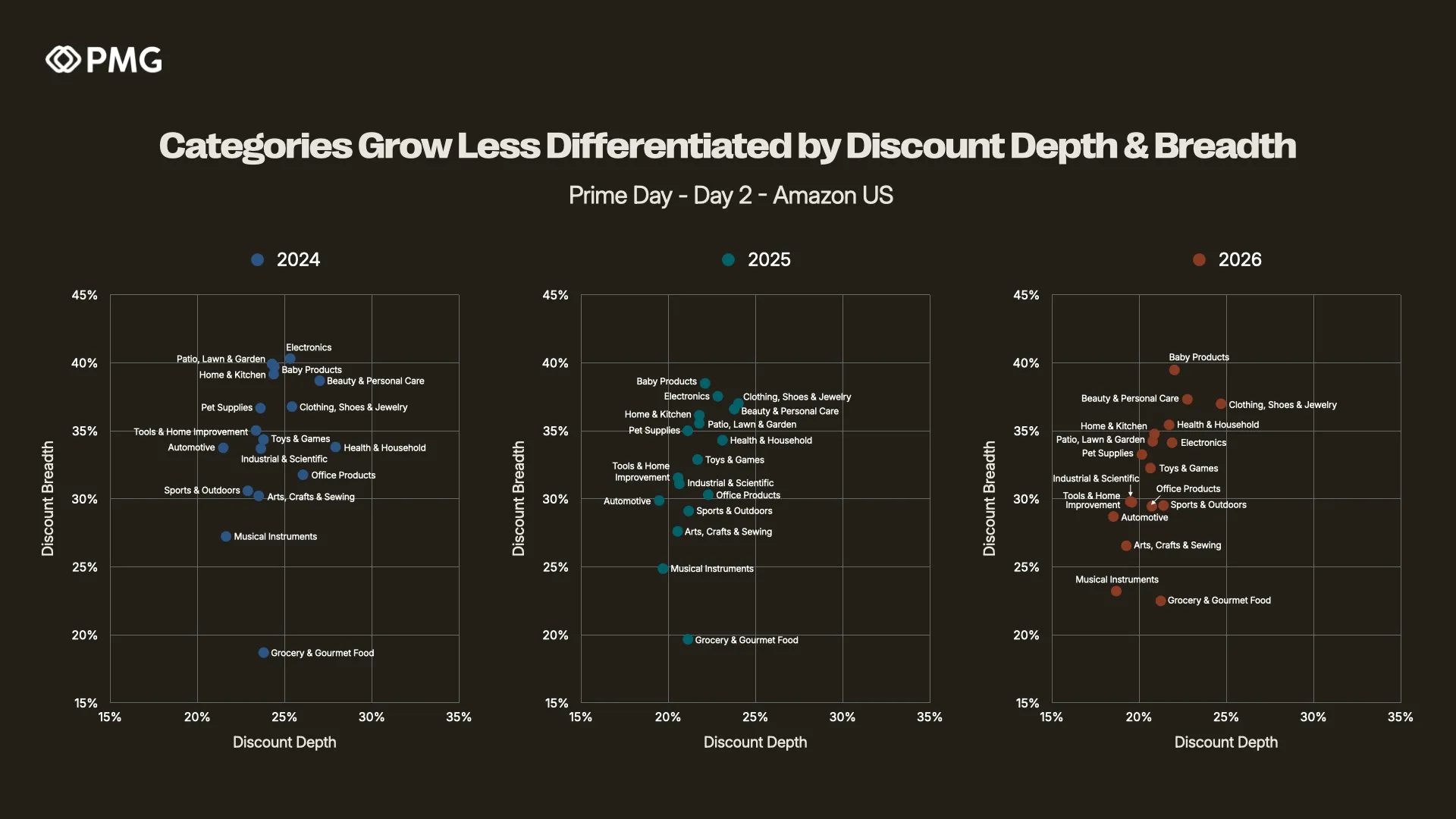
First, discount breadth has narrowed across most categories. Nearly every category is discounting a smaller portion of its catalog than it did in 2024. From 2024 to 2026, the share of discounted products declined in Beauty & Personal Care from approximately 38.7% to 37.3%, in Electronics from 40.3% to 34.1%, and in Home & Kitchen from 39.2% to 34.8%, all key Prime Day categories.
Second, discount depth has moved into a tighter range. The gap between the categories with the deepest and shallowest discounts has narrowed, with most categories now averaging discounts in the low twenties. Categories that discounted more aggressively in 2024, including Beauty & Personal Care at 27.0% and Health & Household at 27.9%, have moderated closer to the overall average, reaching 22.8% and 21.7% in 2026, respectively. Meanwhile, categories that have historically offered shallower discounts have seen relatively little movement.
Overall, the marketplace is now characterized by discounting that is both less widespread and more consistent across categories than it was two years ago. That dynamic necessitates brands executing more nuanced strategies across price promotions, retail readiness, and effective product visibility that takes conversion data into account.
What Brands Should Watch on Day 3 & Beyond
Watch for increasing pervasiveness of relative discounts in the final days: The biggest change between Days 1 and 2 of Prime Day 2026 on Amazon US was in deal breadth, which now closely matches what was observed in 2025. It’s likely this trend could continue in Days 3 and 4, which presents unique dynamics for brands given the typical ‘last hours’ rush of conversion activity.
Contextualizing competitiveness will be paramount: macroeconomic trends are no secret, as consumers are generally craving value, particularly during a sale event like Prime Day. Taking a product-by-product view of relative prices compared with direct competitors on the search page can help inform the overall promotional strategy both on and off Amazon.
Saving proverbial gas for the final push: The aforementioned surge in conversions in the final hours is something every brand should be planning for. Ensure you’re pacing advertising budgets so you can double down when conversion activity picks up in the back portion of the event.