
26 June 2026
Amazon US Prime Day 2026, Day 3: Discounting Holds Steady as Shopping Shifts Earlier in the Day
After Day 2 of Amazon Prime Day saw discount breadth recover to nearly match 2025 levels, a PMG analysis of tens of millions of products on Amazon US for Day 3 of the event shows a marketplace that has largely settled into a steady rhythm. Both the share of products on deal and the average discount rate were essentially unchanged from Day 2, holding modestly below year-over-year (YoY) marks. At the same time, a look at purchase activity reveals a notable shift in the times shoppers are buying, with the early-morning hours capturing a larger share of sales than in 2025.
As the four-day event heads into its final stretch, the key questions are whether brands are holding any additional discounts and promotional budget for the closing push, and whether the earlier-in-the-day buying pattern signals a change in how consumers are engaging with Prime Day.
MethodologyDiscount data included in this analysis encompasses both Prime Day-specific deals and general promotional discounts observed by non-logged-in users across more than 30 million products on Amazon US during Prime Day 2026 (June 23-26). Prior-year comparisons are based on the corresponding days of the 2025 Prime Day event. Sales timing data reflects hourly sales data captured by a consistent set of PMG customers on Amazon US over the same time periods. Collectively, these brands drive over $7B of annual Amazon sales.
Day 3 Discounting Activity Remains Unchanged From Day 2
After Day 2 brought discount breadth back in line with historical norms, Day 3 held that line, with both the depth and breadth of discounts essentially flat versus the prior day.
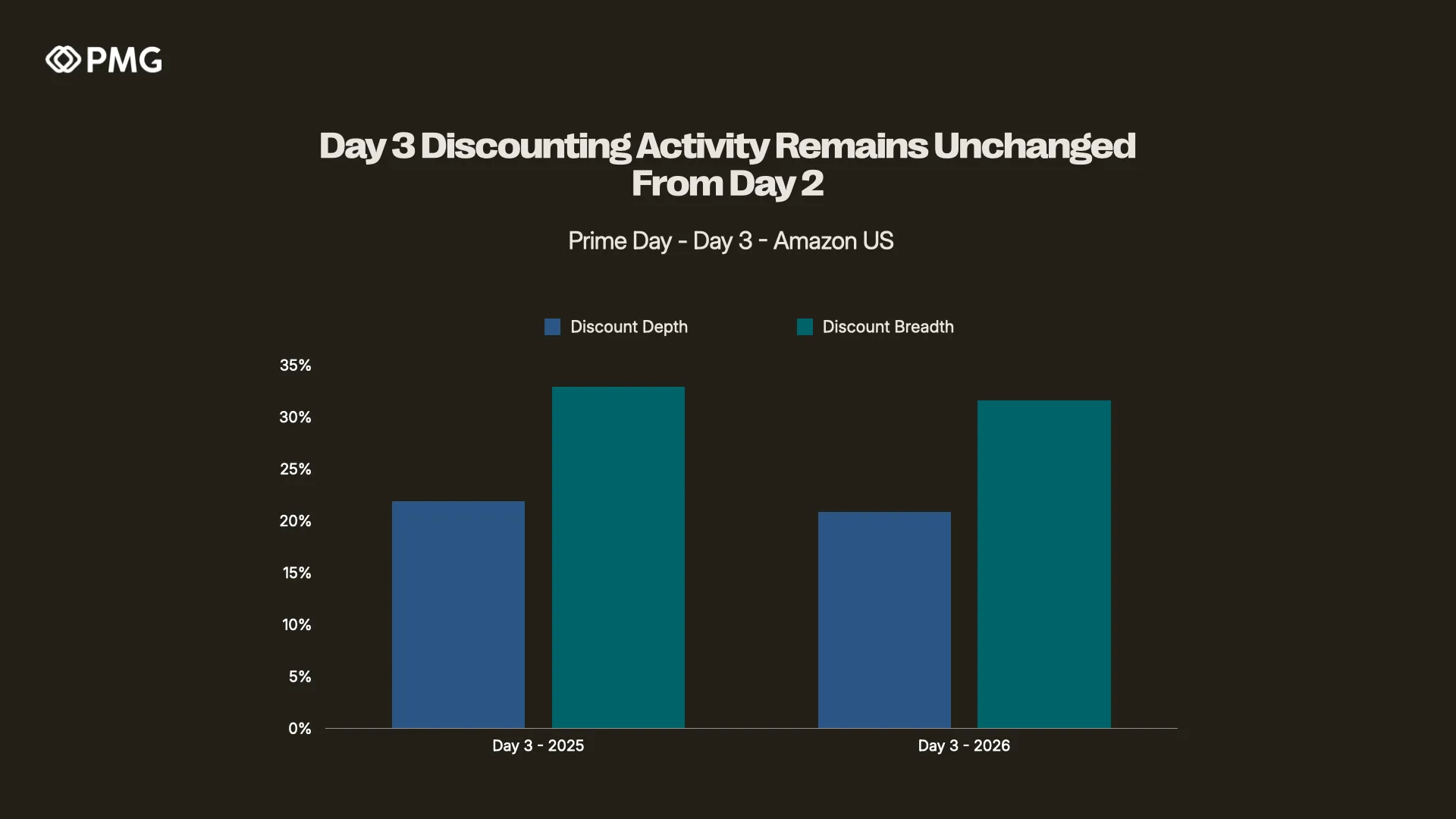
Discount depth held steady: The average discount rate on Day 3 came in at roughly 20.9%, unchanged from Day 2 and modestly below the 21.9% observed on Day 3 of the 2025 event (a YoY change of about -4%, or roughly one percentage point).
Discount breadth also held steady: The share of products carrying any discount came in at 31.6% on Day 3 of 2026, again unchanged from Day 2 and down from 32.9% in 2025, a decline of roughly 4% YoY, or about 1.3 percentage points.
Taken together with the first two days, the trajectory of the 2026 event has been one of stabilization. After a Day 1 that saw breadth down roughly 15% YoY, breadth recovered sharply on Day 2 and has now held at 31.6% through Day 3. Depth, meanwhile, has barely moved across all three days, sitting at 21.0%, 20.9%, and 20.9% on Days 1, 2, and 3, respectively. For brands, the implication is that the promotional posture set early in the event is proving durable rather than escalating as the sale wears on. While that may change for Day 4 of the event, any shifts are likely to be modest in aggregate.
Shallower Discounts Continue to Command a Larger Share of All Promotions
Consistent with the first two days, the distribution of discount offers by depth shows shallower price cuts continuing to claim an outsized share of all discounts offered on the site.
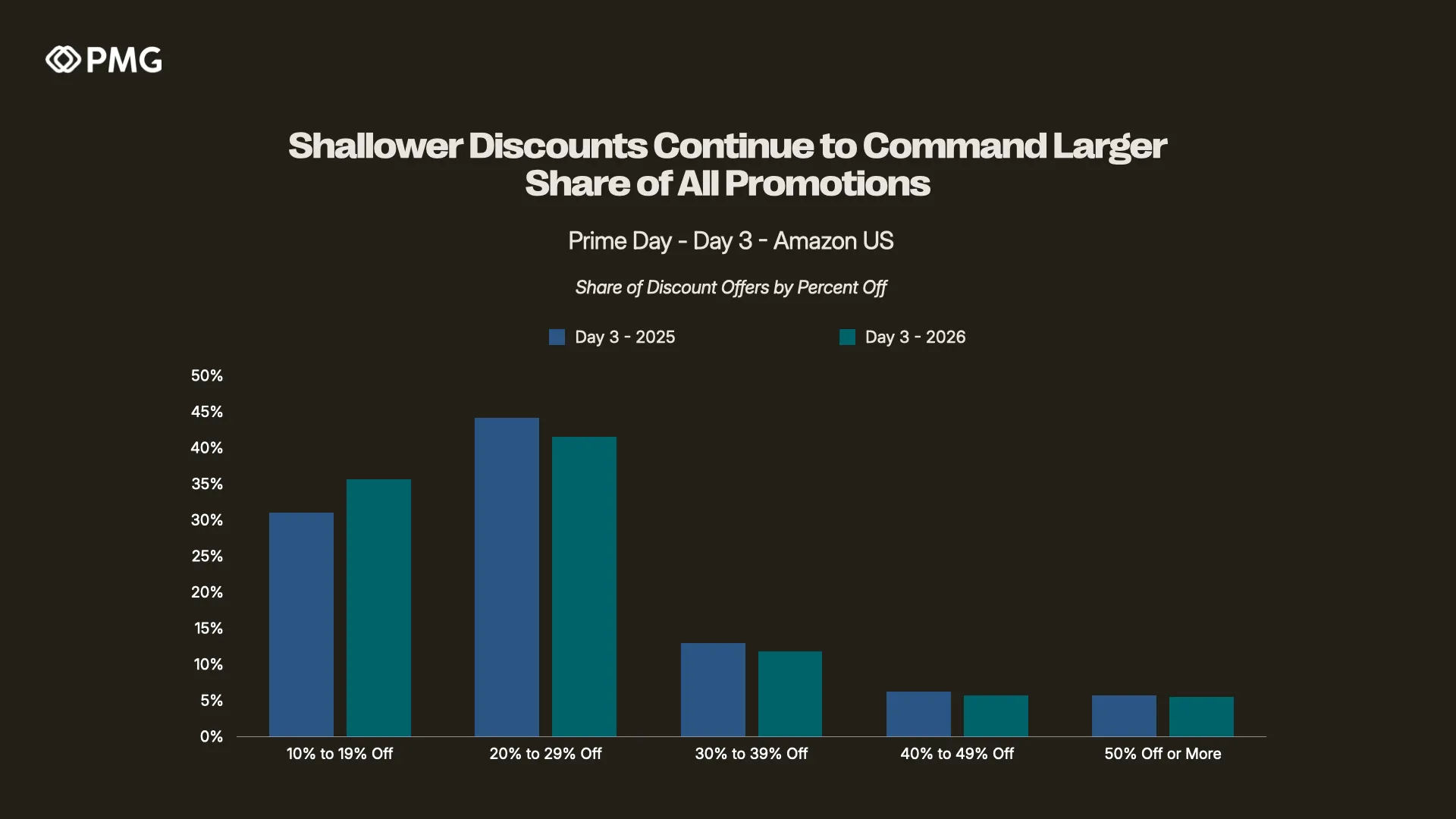
The share of discount offers in the 10%-19% off band rose to 35.6% on Day 3 of 2026, up from 31.0% in 2025, extending the multi-year climb seen on Days 1 and 2.
At the other end of the spectrum, 50% off or more offers held at just 5.5% of discounts, roughly in line with 2025's 5.7% and consistent with the prior two days of the 2026 event.
The 20% to 29% off band, historically the largest group, slipped to 41.5% from 44.2% in 2025, while the 30% to 39% and 40% to 49% bands eased to roughly 11.8% and 5.7%, respectively.
The picture remains the same one observed throughout the event: the "typical" Prime Day deal is getting shallower, with a growing plurality of 2026 offers settling into the 10%-19% range. While standout markdowns are still available, they are less pervasive across the US site than in prior years, raising the premium on how clearly brands communicate the value they do offer.
More Categories Showing Lighter Discounting YoY
Looking beyond whole-site averages, a comparison of discount depth and breadth across top-level categories shows that the lighter discounting evident at the marketplace level is broadening across more of Amazon US.
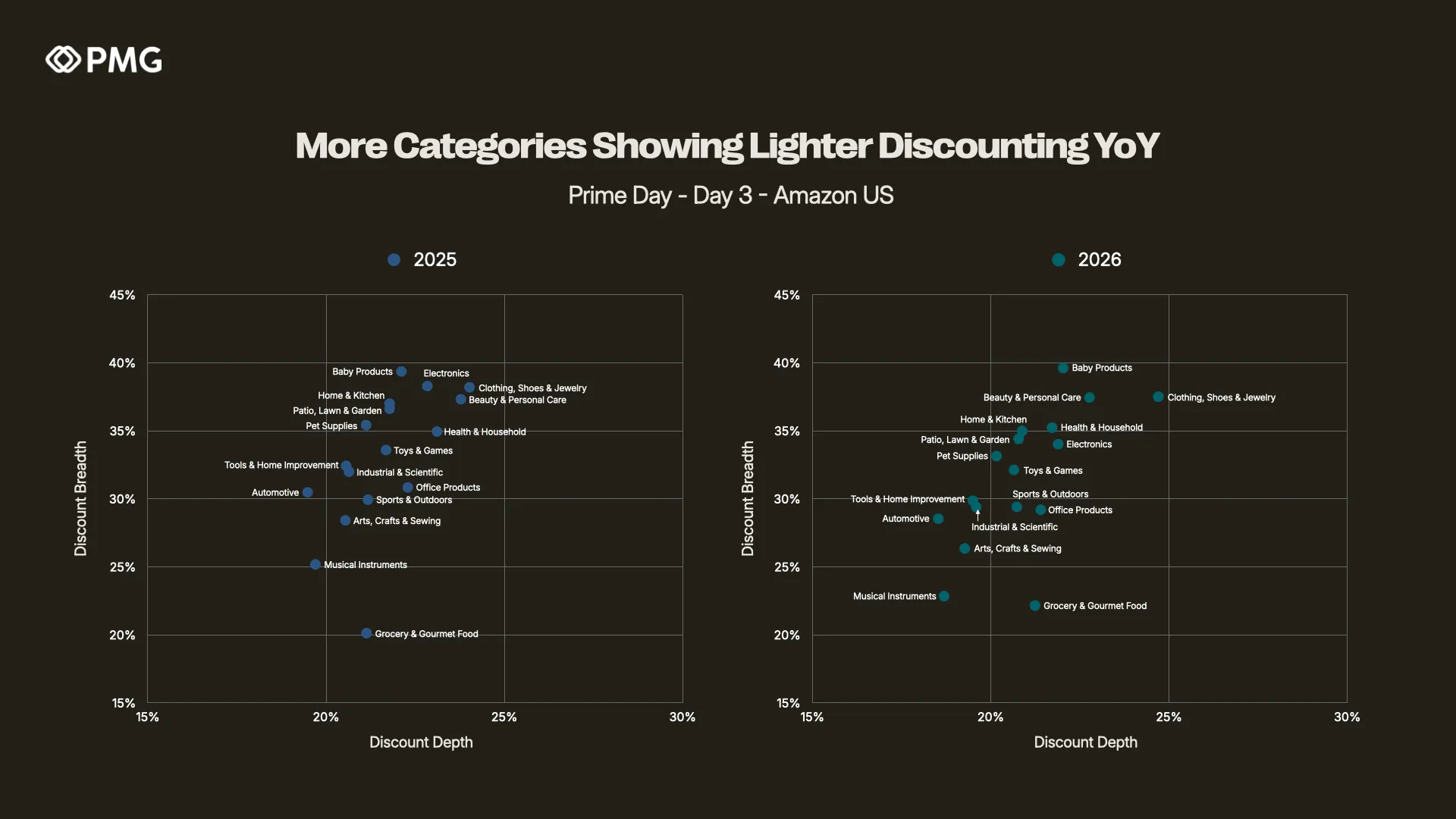
First, discount breadth continues to compress in several of Prime Day's most important categories. From 2025 to 2026, the share of discounted products fell in Electronics from 38.3% to 34.0% and in Home & Kitchen from 37.0% to 35.0%, while categories such as Industrial & Scientific (down 2.6 points) and Tools & Home Improvement (down 2.6 points) saw similar pullbacks. A handful of categories ran counter to the trend, with Beauty & Personal Care (37.3% to 37.4%) and Health & Household (35.0% to 35.2%) holding their discount breadth roughly flat YoY.
Second, discount depth eased across nearly every category. Most top-level categories now average discounts in the low twenties or high teens, with Electronics moving from 22.8% to 21.9%, Home & Kitchen from 21.8% to 20.9%, and Health & Household from 23.1% to 21.7% between 2025 and 2026. Clothing, Shoes & Jewelry was a notable exception, with average depth ticking up from 24.0% to 24.7%, keeping it among the most aggressively discounted categories on the site.
The net effect is a US marketplace where lighter discounting is increasingly the norm across the board during Prime Day. For brands, the compression of discount activity makes standing out increasingly dependent on factors such as visibility, product content optimized for discovery across channels, overall retail readiness, and the ability to flex those elements based on an understanding of relative competitiveness at the product level.
Evening Hours Powering Lower Share of Sales Compared to 2025
With three days of the event now on the books, a new, clearly evident wrinkle is the timing of purchases. Averaged across Days 1 through 3, the distribution of sales by time of day has shifted earlier compared with the same window in 2025.
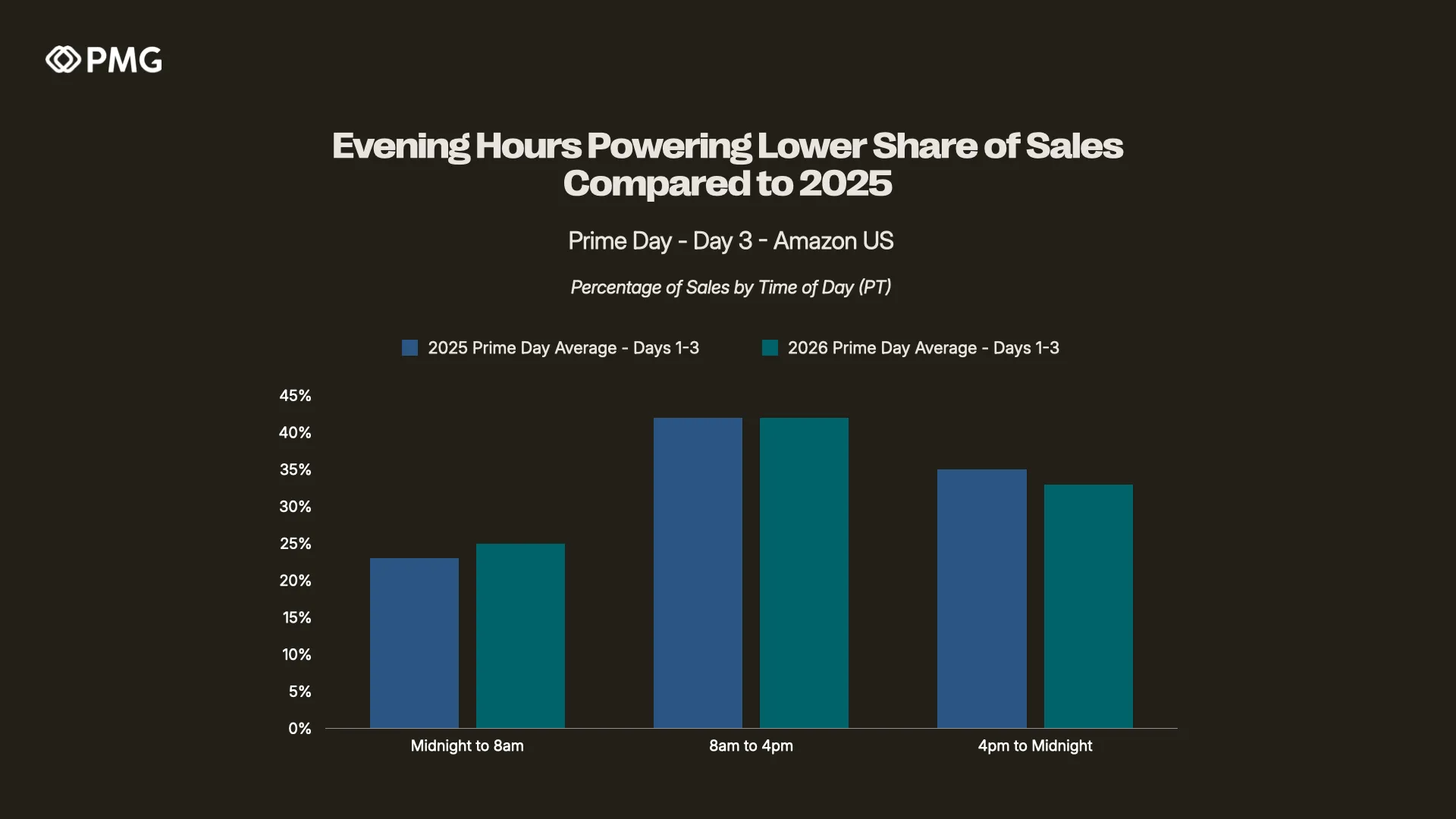
The midnight-to-8 am window captured 25.2% of sales in 2026, up from 23.1% in 2025, a gain of more than two percentage points.
The 8 am-to-4 pm window held roughly steady at 41.7%, down slightly from 42.3% a year ago.
The 4 pm-to-midnight window slipped to 33.0% in 2026, down from 34.6% in 2025, a decline of about 1.5 percentage points.
Evening hours had traditionally been the strongest time of the day during prior Prime Days. The lack of a jump during Prime Time in the US may be due to several factors. These include overlapping World Cup matches, the changed dates of Prime Day, meaning some parents are still managing kids in school, a more muted discount environment that reduces consumer urgency to buy, and broader economic factors that are simply depressing evening shopping generally.
For brands and advertisers, this shift has direct implications for budget pacing and dayparting. Particularly on Day 4, when conversion rates traditionally rise dramatically in the final hours of the sale, brands need to plan for a more muted evening surge and for a portion of sales to stretch into the morning hours after Prime Day officially concludes.
What Brands Should Watch on Day 4 & Beyond
The Day 3 readout reinforces a picture of stability in how brands are discounting, paired with a meaningful shift in when shoppers are buying. A few implications follow as the 2026 event nears its end:
Discounting is set, but the final push still matters: With depth and breadth holding flat across Days 2 and 3, the promotional landscape is unlikely to change dramatically on Day 4. The bigger variable is conversion timing. Day 4 has historically driven one of the largest shares of Prime Day purchases, so brands should ensure budgets are paced to capitalize on that closing surge, at a level that matches the sales volume seen as it develops.
Account for the changing buying curve: With more sales landing in the morning and fewer in the evening than in 2025, brands should revisit dayparting assumptions and ensure bids and budgets have greater flexibility in the back half of the day to reflect changes in consumer activity.
As the final day of Prime Day 2026 unfolds, PMG will continue to track how these dynamics evolve, with particular attention to whether the closing-hours conversion rush holds to historical form and whether the steady discounting posture seen across Days 2 and 3 carries through to the finish.