
18 June 2026
Amazon US Prime Day 2026 Sales Estimated to Rise Between 4-7% YoY, With Shallower Discounting
PMG’s latest Amazon marketplace forecast estimates that US Prime Day 2026 sales will rise between 4% and 7% year-over-year (YoY), signaling another year of growth for Amazon’s summer shopping event, though in a more complex demand environment than in years past. This is despite the continued trend of shallower average discounting during peak sales events, a consistent YoY theme since 2025 that we expect to continue.
On the sales front, PMG’s forecast points to continued resilience in one of retail’s most important mid-year sales moments, but the topline growth range also warrants a closer read. With inflation running at roughly 3.8% YoY, the low end of the forecast would represent essentially flat inflation-adjusted growth, while the upper end suggests moderate upside driven by promotional intensity, category momentum, and consumers’ continued focus on value.
Regarding discounts, PMG estimates that the average discount depth across the site will be -12% shallower YoY. This would be similar to the -11% YoY decline in average discount depth observed across the site between the 2025 and 2024 events
On top of brands needing to manage sales amid broader macroeconomic trends, another source of uncertainty is the new calendar dynamic, with this year’s Prime Day event running June 23-26. This pulls the sale period ahead of its typical July timing and creates a different set of consumer, cultural, and competitive signals for brands to navigate.
A New Prime Day Calendar Creates More Unknowns
Prime Day has become one of the clearest demand signals of the summer retail season, but 2026 introduces a timing shift that makes the event harder to compare directly to prior years.
In 2025, Prime Day ran from July 8-11, while this year’s event moved up to June 23-26. That earlier timing gives shoppers access to deals ahead of Independence Day and the heart of summer travel and outdoor entertaining, but it also changes the context around purchase intent.
This year, several variables could influence how consumers respond:
Pre-July 4 spending could help lift demand in select categories. With America’s 250th anniversary approaching on July 4, shoppers may be more likely than in other years to stock up on entertaining, grocery, apparel, outdoor, travel, and home goods categories ahead of a larger-than-usual holiday moment.
Experience spending could compete with discretionary retail. The same holiday timing could pull wallet share toward travel, events, dining, and entertainment, especially for consumers already managing tighter budgets.
The World Cup may reshape attention and category demand. Prime Day will land in the middle of the 2026 FIFA World Cup, creating possible upside for categories like TVs, streaming devices, fan gear, sports apparel, snacks, grocery, and home entertaining. At the same time, the tournament could fragment consumer attention and media engagement during a critical promotional window.
Back-to-school behavior may start earlier. Amazon’s own Prime Day positioning highlights summer and early back-to-school needs, suggesting the event may increasingly serve as a bridge between summer shopping and early Q3 planning.
The Sales Forecast: Growth, But With Caveats
PMG’s model estimates 4-7% YoY growth for Prime Day 2026 on Amazon US.
At face value, that range suggests positive momentum. But in the current inflationary environment, the difference between nominal and real growth matters. With CPI up roughly 3.8% YoY, a 4% Prime Day gain would indicate that much of the increase may be price-driven rather than volume-driven. In other words, the bottom of the forecast range points to a Prime Day that looks stable, but not materially stronger, after adjusting for inflation.
The upside case is more encouraging. A result closer to 7% would indicate that Prime Day continues to expand its role as a major retail demand driver, with growth likely supported by strong deal-seeking behavior, broader participation across categories, and consumers using the event to consolidate planned purchases.
For brands, the key takeaway is that Prime Day growth should not be interpreted as a straightforward demand-acceleration story. Instead, performance will likely depend on how well brands align pricing, inventory, media pacing, and creative messaging with a value-conscious shopper who is still willing to spend, but increasingly deliberate about when and where.
The Discount Forecast: The Downward Trend Continues
PMG estimates that the average discount rate offered on Amazon US over Prime Day 2026 will drop -12% YoY. Looking across recent major sale events on Amazon US, a consistent pattern has been that the average discount is lighter than the prior year. To wit:
2026 Big Spring Sale average discounts were 4% lighter than 2025 event averages
2025 Cyber Week average discounts were 18% lighter than 2024 event averages
2025 Prime Day average discounts were 11% lighter than 2024 event averages
Notably, the change in the share of products offering any discount hasn’t shown a similarly consistent trend. This likely reflects the reality that brands view discounts as a prerequisite for driving Prime Day success, even if the discounts they can ultimately offer aren’t as good as in prior years.
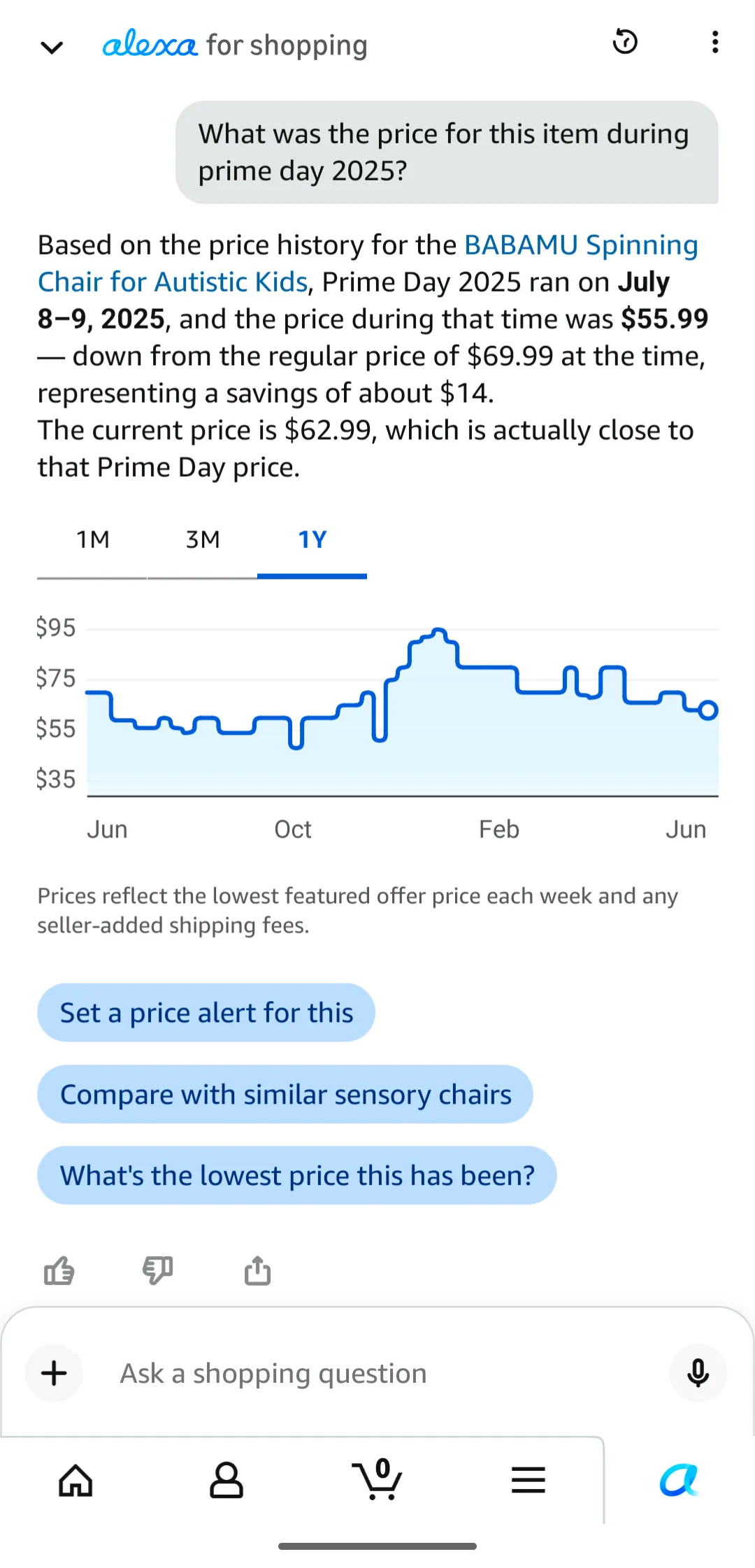
Increased adoption of agentic shopping tools, including Amazon’s Alexa for Shopping, may make this dance harder for brands to pull off. Users can now, directly within the Amazon app, ask for price history on a given product.
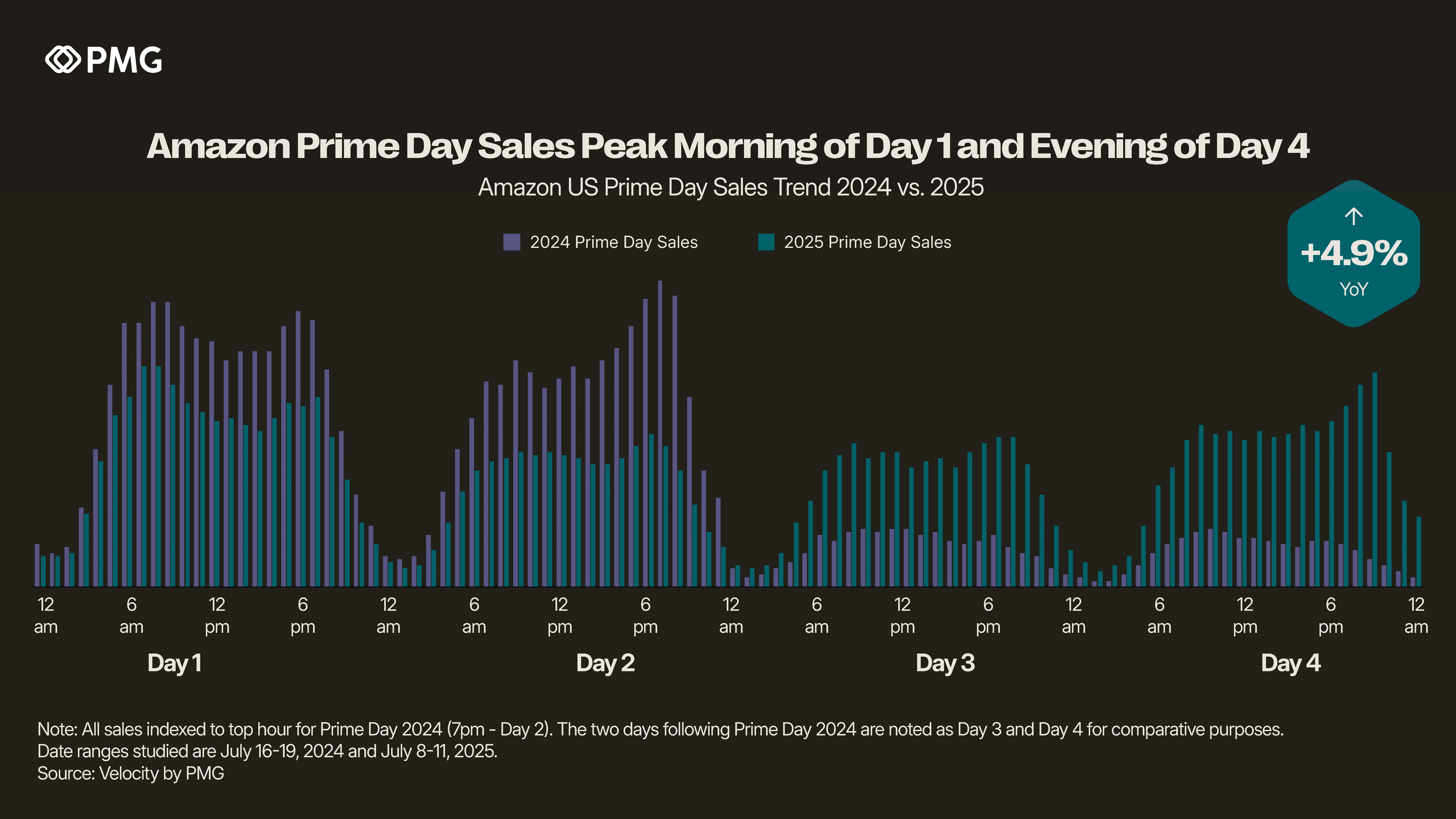
Brands need to deploy discounts strategically during Prime Day in ways that align with peak purchase windows and remain competitive with similar products. This likely entails focusing on Days 1 and 4 of the event, which drove the most volume in 2025 and are likely to see similar dynamics in 2026, and conducting deeper research into top competitors' discount strategies from past sales events.
Methodology: How PMG Built Each Forecast
To estimate Amazon US Prime Day 2026 sales growth, PMG analyzed three years of weekly Amazon market data and trained a series of time-series forecasting models across the dataset.
The modeling approach combined SARIMAX and Facebook Prophet forecasting models to account for underlying sales trends, seasonality, and event-driven movement across the Amazon marketplace.
To validate model accuracy, PMG withheld the most recent 20 weeks of data from the training set. Each model was trained on the dataset excluding that final 20-week window, then tested against the withheld period to determine which approach most accurately predicted recent market performance.
The model that best predicted the last 20 weeks was selected as the basis for the Prime Day forecast. Given this year’s calendar shift, the concentrated four-day sales window, and the number of macro and cultural variables surrounding the event, PMG expressed the final estimate as a range rather than a single-point forecast.
To estimate changes in the discount depth of Amazon US Prime Day 2026, PMG analyzed the past two Big Spring Sales, Prime Days, and Cyber Weeks on the site. PMG analyzed discount data for tens of millions of products on Amazon US for each of those sale events.
To more accurately describe the broader market environment and reduce the impact of outliers, aggregate discount and pricing data are weighted by each product’s monthly search volume.
The average YoY change in discount depth for each event was then weighted by total Amazon US sales observed in each week containing the respective sale event to arrive at the 2026 Prime Day estimate.
Macro Headwinds Will Put More Pressure on Value
The consumer backdrop heading into Prime Day is more complicated than it was during last year’s event. Inflation remains elevated, price sensitivity continues to shape purchase decisions, and consumers across income levels are making more deliberate trade-offs.
This does not mean shoppers are pulling back entirely. It does mean that promotional events must work harder to convert demand.
Prime Day is well-positioned for that environment because it gives consumers a reason to act. But shoppers are likely to be more selective, more comparison-driven, and more focused on categories where discounts feel meaningful. Brands should expect consumers to prioritize essentials, planned purchases, high-perceived-value deals, and items tied to immediate seasonal needs.
For advertisers, this raises the stakes on retail media strategy. Visibility during the event will matter, but so will the ability to reach shoppers before the event, reinforce value during the four-day window, and retarget consumers afterward as Prime Day signals begin to inform back-to-school, fall, and holiday planning.
What Brands Should Watch
Deal depth and perceived value. In a higher-inflation environment and with more tools available to shoppers than ever before, modest discounts can’t be seen as a panacea. Competitive discounts and easy-to-understand promotional messaging will be critical.
Category-level divergence. Growth will not be evenly distributed. While sales will undoubtedly spike, seasonal categories, grocery and household essentials, electronics, home entertaining, sports-adjacent products, and school supplies may see vastly different demand curves.
Media pacing across four days. The expanded event window requires brands to pace their advertising spend and promotions. Days 1 and 4 are expected to drive the largest shares of purchases, with many consumers focused on grabbing top deals on Day 1 and waiting for any final Day 4 deals before closing out their shopping carts.
Calendar-adjusted comparisons. Year-over-year readouts should account for the move from July to June. Brands should be cautious about interpreting performance without considering timing, promotional cadence, and the broader retail calendar.
The post-event halo. Prime Day performance can reveal early signals for H2 demand. Search behavior, category engagement, price sensitivity, and conversion trends should inform back-to-school and fall promotional planning, as well as holiday readiness.