
17 August 2026
Everyone's Talking About Agents. Ours is in Production.
Every marketing leadership meeting this year comes back to the same word. Agents. They're on the roadmap, in the keynote, halfway through a pilot that started two quarters ago and isn’t trusted to do anything. The pitch is always some version of the future: here's what an agent could do for your team, once it's built, once it's trained, once it's connected to your data. It's an easy promise to make. It's also, almost everywhere you look, still a promise.
PMG’s Ask Alli is the exception. Not what an agent could do next year, but what ours did this morning, inside a real account, on real numbers, delivering real impact for real customers. All in production.
Ask Alli is the conversational agent inside Alli, PMG's operating system. Alli connects a brand's data, strategy, and execution into a single platform powered by one clean, contextual data foundation. That foundation lets a single agent work across the whole operation, not just one corner. It's live, in production for every PMG customer today, not a select few in a pilot.
What "in production" actually means
Most of what gets called an agent is a demo, a pilot, or a one-off prompt. These demo agents often answer questions someone planned in advance, on data someone manually cleaned first, in a setting built to make it look good. A pilot is just a demo with a longer leash, still walled off from the real stack and watched by the people who set it up. Both can look impressive. Neither is doing the work that truly impacts your business.
An Alli production agent clears a higher bar. Our agent works from live, governed data, the same foundation the rest of the business runs on. It sits inside the tools your teams already use, so nobody leaves their workflow to reach it. And it earns enough trust to bring its answers into a budget conversation, because every number traces back to a source the room already agreed on.
That's the line most of the category can't cross. A demo answers the question you gave it. Ask Alli answers the question you actually have, against your real numbers, in the moment you're asking. It's trusted enough to act on, and it's there when the work needs doing.
Answering, building, conversing, running the play
Ask Alli runs through every part of Alli. Here are four moments that show what it does when you put it to work, each asking more of it than the last.
It starts by answering. In Alli Data Explorer, a media lead asks how spend is paced against revenue this month and gets a verified answer in plain English, in the room, not a report three days later. No ticket, no analyst queue. Then the harder ask: the three insights worth walking into an executive review with, and what to do about them. Ask Alli reads the pattern, shapes the insights for that room, and names the actions. The team walks in ready, not still waiting on the deck.
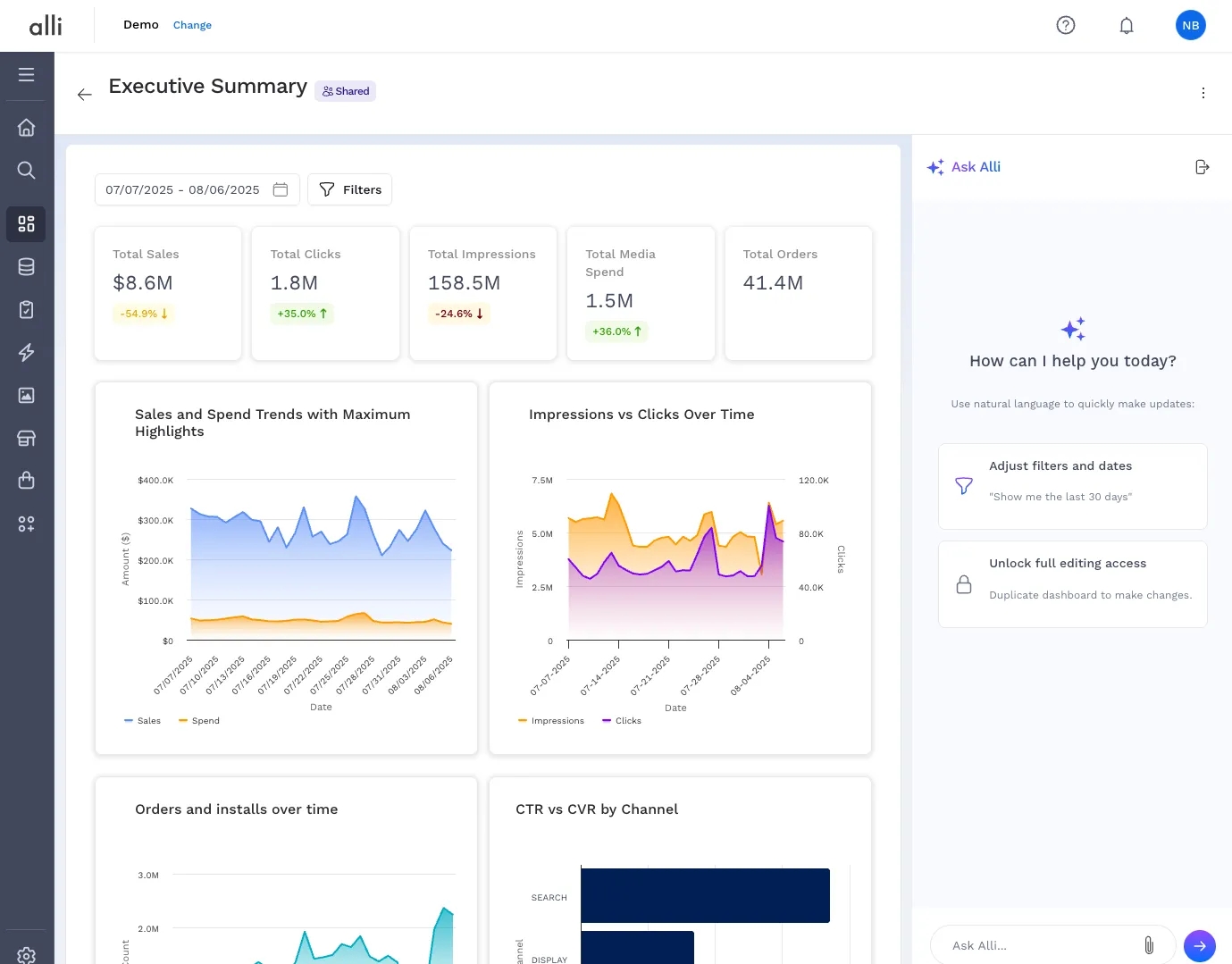
Then it builds. In Alli Generative Dashboards, the same plain language that pulled an answer now makes something. Type a sentence, build an executive summary dashboard with the top KPIs across media, and the board appears. Change your mind mid-review, ask for a month-on-month comparison on one chart, and it updates on the spot. Nobody opened a chart editor. Nobody filed a request.
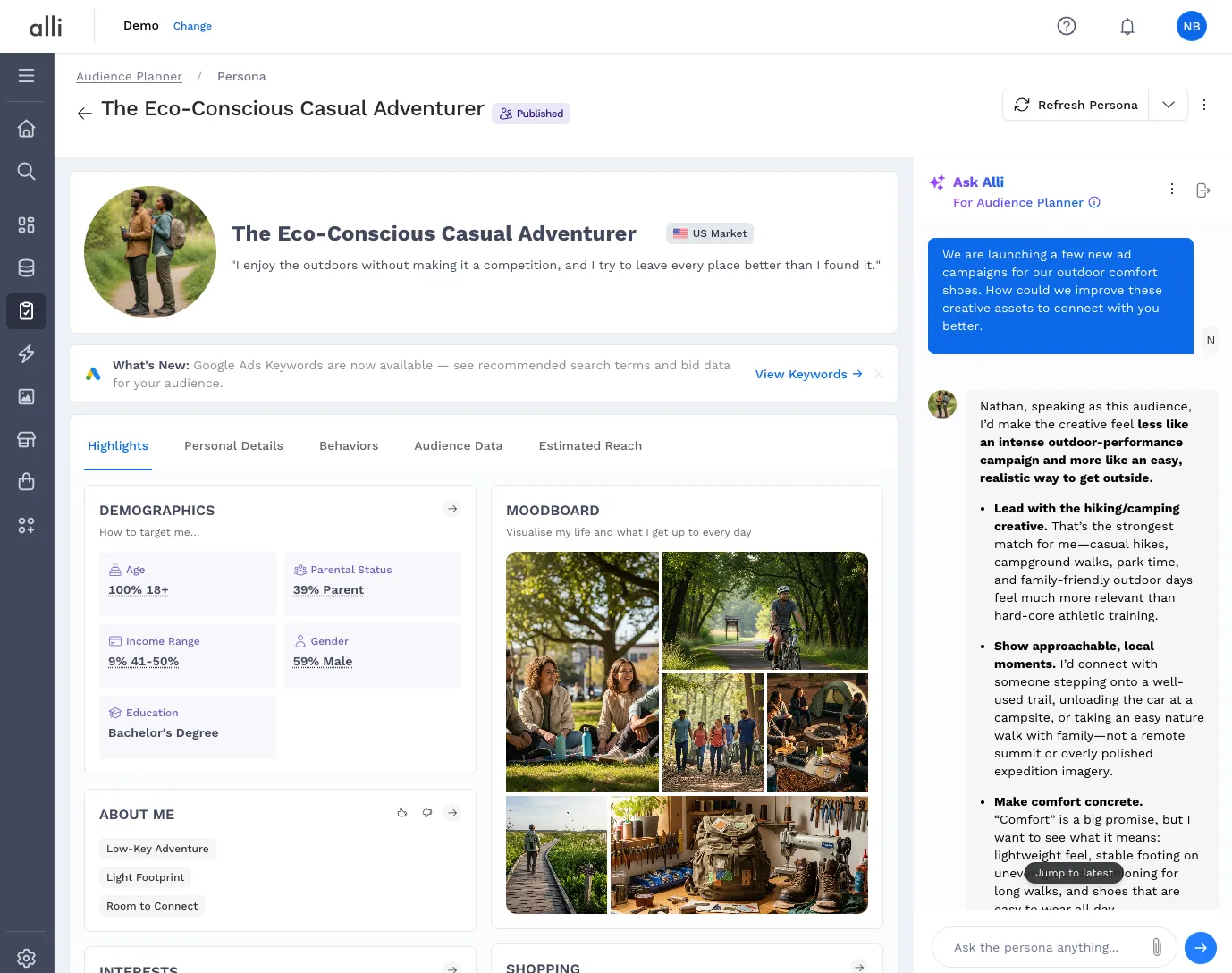
Then it converses. In Alli Audience Planner, describe the audience you want—outdoor enthusiasts who are casual but care about sustainability—and Ask Alli builds the persona. Here's the part a report can't do: you talk to it. Ask what this audience does with their family on a weekend. Then show it the creative you're about to launch and ask how to make the work land harder. It answers and has an opinion on which asset connects best. That's audience research you can talk through before you commit a dollar of media.
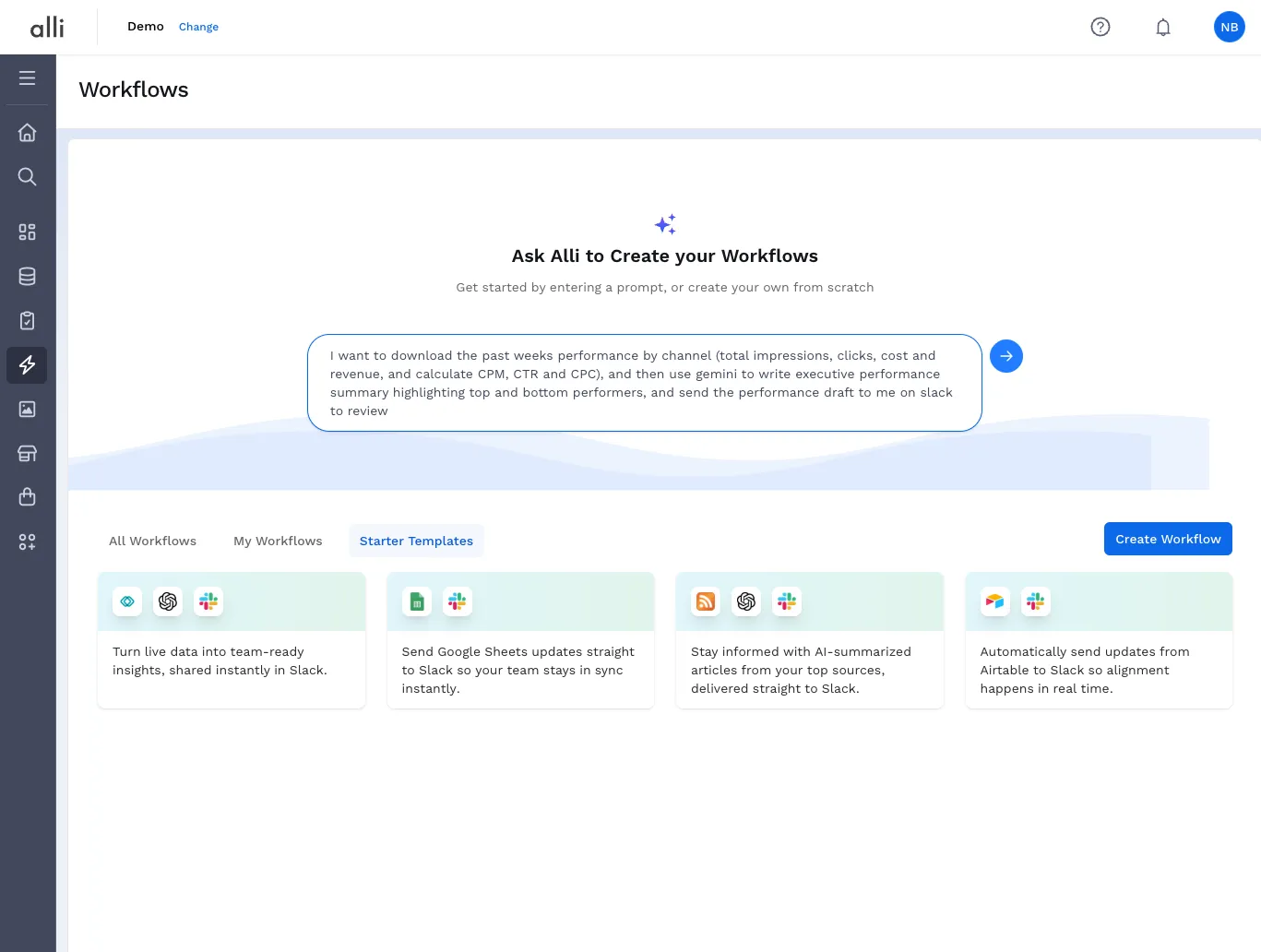
Then it runs the play. In Alli Generative Workflows, a practitioner describes the whole job in one prompt: pull last week's performance by channel, calculate the efficiency metrics, write an executive summary of the top and bottom performers, and send the draft to Slack to review. Ask Alli writes the SQL, generates the summary, and delivers it where the team already works. Nobody wrote a query. Nobody exported a file. The work showed up finished.
These are four moments out of many. Ask Alli is in every product across Alli, which means the same plain-language interface that answered a question can build the dashboard, talk to the audience, and run the workflow, anywhere your teams already are.
The part a demo can't fake
So why would you trust an agent to act on any of this? Generic agents make people nervous because they act confidently on unvetted data and missing context. Confidence without grounding is exactly the failure mode a marketing leader is right to fear, because a wrong number delivered smoothly is worse than no number at all. Ask Alli's answers hold up for one reason: everything it does draws from the same governed data foundation that powers our entire platform. The question in Alli Data Explorer, the dashboard it automatically builds, the persona it creates, and the workflow it runs all pull from one connected, defined set of numbers.
That's the part a slick demo can't reproduce, because it isn't a feature you can show in ninety seconds. It's the years of data work underneath, the pipelines, the definitions, the governance that make every answer traceable back to a source the business already trusts. The confidence isn't in the interface. It's in what the interface stands on.
You don't need a roadmap. You need a login.
Most agent pitches ask you to imagine or show you an agent demo. Getting you to imagine what your team could do once the thing is built, trained, and connected.
We'd rather show you what it already does. Ask Alli is running in production today, grounded in the data your teams already trust, inside the tools they already use. The gap between talking about agents and running them is becoming a competitive advantage, and it favors teams that can ask, build, converse, and act inside one system while everyone else is still waiting on reports and debating whose number is right.
None of this asks your people to become data scientists or to give up the expertise they've spent years building. It removes the friction between a question and an answer, and between a decision and the work that follows. The people stay in charge. The waiting goes away.
The future everyone keeps describing in the meeting is, for the teams already using Ask Alli, just Tuesday.