
Today, 99% of advertisers report working with creators, according to the WFA. Unilever plans to direct 50% to 70% of its $9 billion to $10 billion advertising budget toward creators and social, and it brought 50,000 creators into this year’s World Cup campaign. Meanwhile, 72% of brands expect to increase influencer spending in 2026.
We are playing in a transformed landscape where scale is essential to win. AI can take repetitive work off teams’ plates, giving people more time to think, create and make the strategic decisions that set brands up for success. Used well, it helps teams move faster while keeping human judgement at the centre of creator work.
As agentic solutions mature, that model is becoming practical. Combined with sustained human investment, AI helps marketers work with more creators and make better decisions faster. The advantage comes from creating more room for the choices that shape the work, from who to partner with to which ideas deserve investment.
Before AI, a small group of creator-first brands had already found ways to scale. They built specialist teams and used automation and disciplined workflows to deliver more partnerships without lowering standards.
Agentic AI makes these scaled workflows accessible to more brands.
Scale Starts with Better Creator Decisions
Agentic workflows can give teams back time that would otherwise be spent sourcing, manually checking, contacting and briefing creators. In some campaigns, these processes have consumed as much as 80% of the team’s time and remained prone to error. Agents can reduce that burden while improving consistency and accuracy. Every hour returned gives teams more space to understand creators, strengthen the brief and make better calls.
With clear guidance, defined processes and humans in the loop, agents can support work such as the following:
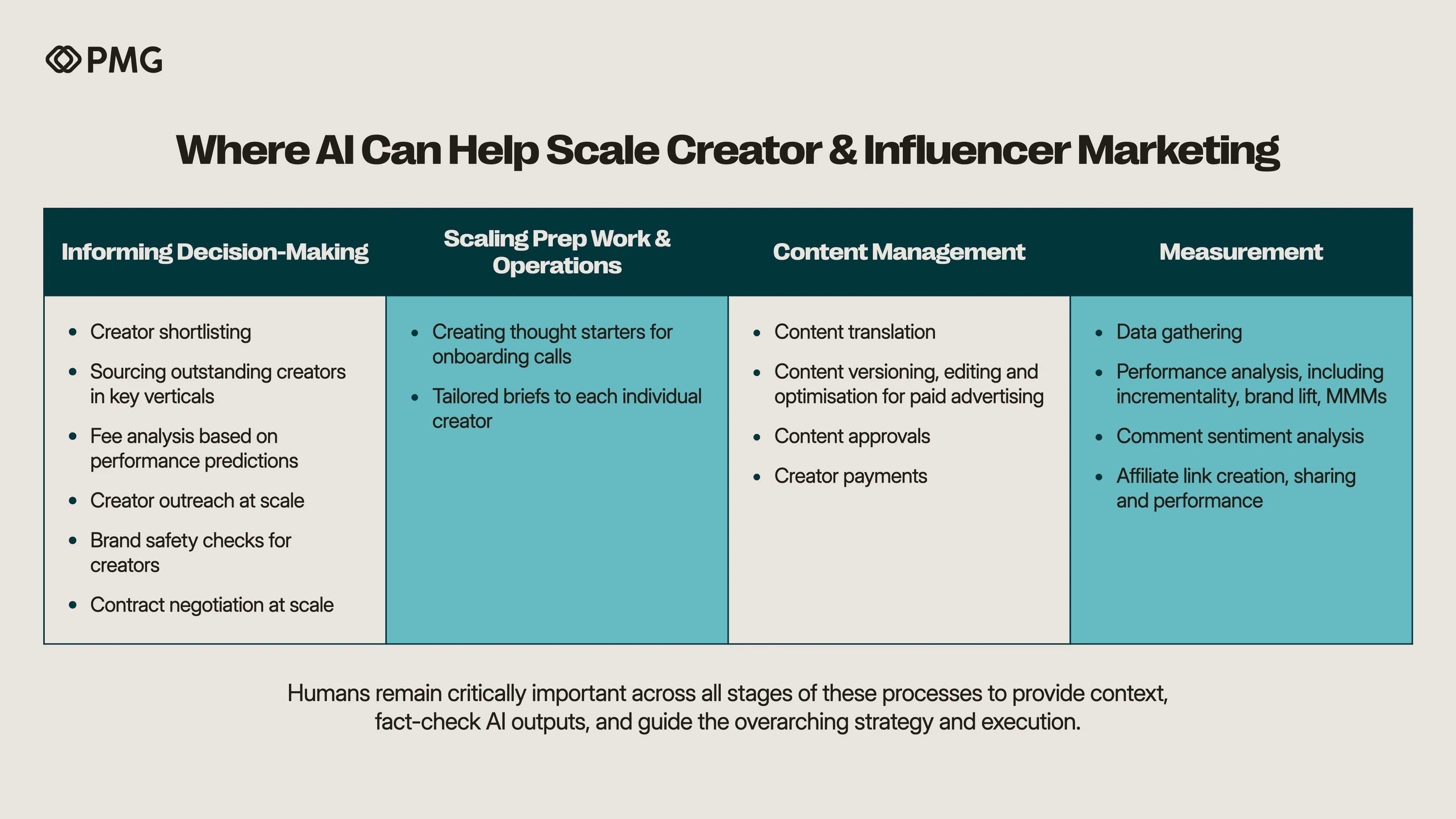
Using AI Should Make Every Brief More Personal
Scaled programmes have often relied on giving creators the same concepts and scripts. However, creators can usually tell when a brief could have been sent to anyone, and audiences often can too. The result can feel turnkey and predictable, limiting attention, engagement and impact. While agentic workflows make it possible to personalise creator briefs, campaign ideas, and strategic thinking, they can also help teams improve content quality without imposing a single creative formula when applied strategically to the workflow.
At PMG, we recommend onboarding calls that help teams build long-term relationships with creators and develop stronger content ideas. The starting point is simple: Make creators feel understood. With humans focused on relationship building, agents can be used to search a creator’s past content for thought starters based on what has performed well and what suits the brand’s requirements. That preparation gives both sides, the creator and the brand team, a more useful place to begin the conversation.
AI Can Help More Content Work Harder
Content production, editing and approvals are easier to scale than ever. As brands work with creators globally, marketers still need to ensure that content follows the brief, complies with advertising regulations, and performs. Agentic workflows can check assets against specific requirements, guardrails, and best practices, while people should continue to make the calls that require context and judgement.
"Creators can usually tell when a brief could have been sent to anyone, and audiences often can too. The result can feel turnkey and predictable, limiting attention, engagement and impact."
Creators now sit at the centre of many media plans, so brands also need a genuinely integrated perspective. Their content may need to work across paid media, owned social, creator channels, TV, CTV and out-of-home placements. That puts pressure on creators to deliver more assets and on brands to optimise each one. Here, AI tools can support editing, message optimisation, and performance improvement without dictating the creative idea.
Faster Measurement Leads to Better Decisions
Influencer reporting has been too manual and time-consuming for too long, as teams often spend more time gathering and validating data than learning from it. The longer that process takes, the less useful the learning can become. Agentic systems can shorten the cycle, examine more variables, and help teams turn data into useful insights sooner.
Their value goes beyond retrospective reporting. Faster insight helps marketers shape future campaign approaches and content requirements while the learning is still useful. As influencer budgets grow, so does the pressure to demonstrate commercial impact. Agentic support can help teams identify where that impact may lie, optimise future performance, and integrate creators more fully into measurement.
Scale Human Judgement Alongside Automation
The power of working with creators is fundamentally very human. Their influence grows from parasocial relationships, the sense of trust, and connection audiences build with someone they may never meet. Because people often respond best to creators who reflect their interests, experiences, or aspirations, marketing teams need to keep those real relationships at the centre of their operating model, inviting creators to bring forward ideas and judge what will resonate with their audiences.
Brands that get this right can work with more creators while investing more deeply in those relationships. Agentic solutions can take manual work off stretched teams and free up time for creator conversations, experiential marketing, and the creative and strategic craft of campaigns.
Unilever Shows What Human-Led Scale Can Deliver
Unilever’s FIFA World Cup 2026 campaign illustrates the potential of this model at extraordinary scale. More than 50,000 creators helped the campaign reach over 2.5 billion people across 120 markets during the 39-day tournament, and those figures demonstrate reach, though they do not by themselves prove long-term business impact.
Fernando Fernandez, Unilever’s CEO, expects the company’s advertising shift to strengthen awareness and product differentiation over time. The short-term commercial picture is encouraging, but it should be read with a few considerations in mind. In Q2, the company reported 5.5% volume growth and a further 0.3% from pricing, its strongest volume growth in 15 years. According to the earnings report, the World Cup creator campaign for Unilever formed part of that broader performance rather than proving it on its own. Marketers should therefore exercise caution about applying lessons from one campaign or brand too broadly.
Creative Freedom Helps Scale Without Fatigue
Unilever’s execution also shows how scale can coexist with creative variety. Its teams put content production at the centre of the strategy while giving creators flexibility over what they made. At the House of Fresh activations in New York City, Miami, and Mexico City, 2,100 creators produced more than 6,000 pieces of content for Unilever during the tournament. The spaces gave personal care brands a visible presence without relying on prescriptive briefs. That flexibility likely contributed to their average engagement rate of 16%.
Creator-led work was complemented by Personal Care’s AI Content and Creative Studios, which produced 18,000 assets for 120 brands during the World Cup. AI was also used to support forecasting and production cut-offs for 180 FIFA World Cup 2026 products. In each case, AI played a supporting role in bringing products, creator workflows, and content edits to market. The key learning for other marketers was how Unilever maintained a practical yet scaled application of AI across various aspects of its broader World Cup strategy. The humans, both Unilever’s marketing team and the creators they partnered with, remained central to driving the more strategic and creative elements of content production and execution, whereas AI systems helped deliver scale and operational efficiencies.
Final Thoughts
The next phase of creator growth in influencer marketing will belong to brands that scale the system using AI without scaling away judgement. With creators responsible for influencing search, AEO, experiential marketing, integrated media, affiliate programmes, owned social and new product development, the work of growing a brand and delivering results for the business has never been more human.
In this era of AI efficiencies and new technologies, the operating imperative is clear. Use AI to remove friction and surface insight faster, giving people more room to make the creative and strategic decisions that drive impact. That is how scale becomes more human, not less.


