
Over those five days, my team and the founders frenetically whiteboarded what would become the blueprint for the first modern demand-side platform, Invite Media. Google later acquired the company, and the platform is now known as DV360. Great entrepreneurs with a great story.
I bring this up because history may be repeating itself, but today, the stakes are higher. A new generation of technology has emerged called unified media platforms (UMPs) that could change how marketers operate and how quickly they make better decisions.
First, some context. When Invite Media began, traditional broadcast media still dominated. Digital media was emerging, but it was concentrated in a handful of web portals, including Yahoo, AOL, and MSN. Ad inventory was entirely desktop-based, formats were largely uniform, and marketers had the luxury of persistent first- and third-party cookies for measurement.
Since then, technology and media have shifted in waves, from mobile and social to digital video, connected TV, and now AI. Walled gardens, including Meta, Google, Amazon, social apps, and retail media networks, have expanded across devices and surfaces. The open web that produced programmatic media and DSPs is now, at best, a minor channel. Traditional broadcast media have also waned, with live sports providing one of their last strongholds. The result is a deeply fragmented media landscape and equally fragmented consumer attention.
For marketers, that fragmentation has created extraordinary complexity. Siloed partners and a relentless stream of creative formats place unsustainable demands on organizations across planning, operations, creative, activation, and measurement. The rapid AI innovation we see making headlines is only adding pressure. Marketers urgently need simpler, more automated workflows, centralized planning, activation, and measurement, integrated marketing mix modeling, and more fluid budget allocation.
In short, they need an operating model built for faster, better decisions.
Unified Platforms Can Coordinate a Fragmented Market
There’s a long history of marketers turning to third-party media management platforms such as Kenshoo, Marin, and Smartly to help tame the chaos. But those platforms were built on legacy technology and APIs. They managed channels and partners in silos and lacked recent AI capabilities such as large language models and generative AI. They offered streamlined interfaces and workflows, but not unified decision-making.
Modern AI is enabling a new category of media management software via unified media platforms, or UMPs. Their promise is not simply a cleaner interface, but a system that can coordinate decisions across channels.
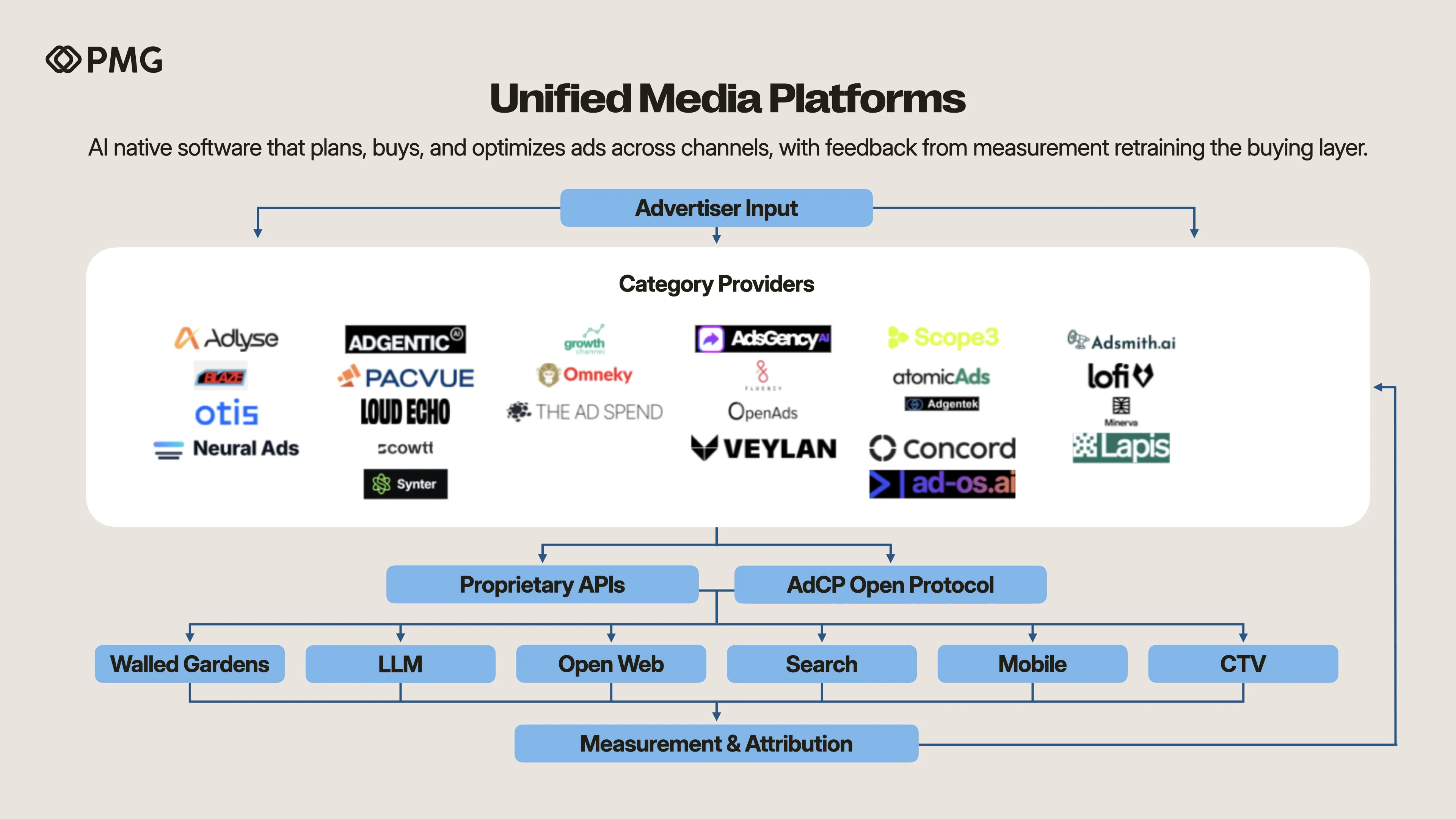
A recent post from venture capital firm Aperiam offers a useful description of how these platforms work: “These platforms connect directly to the APIs of major media providers—Meta, Snap, The Trade Desk, Google Ads—and layer a unified UI and an AI decision engine on top. Instead of logging into each platform separately to build and manage campaigns, you work from a single interface. Set up a campaign once, push it across platforms, pull results back into the same tool, and let the AI analyze performance and inform what comes next. The loop is continuous, and it gets smarter over time. In the most forward-looking implementations, you're not even clicking through a UI; you're working at a command line, describing what you want and where to find your seed audience, and the system takes it from there.
The benefits are real: agentic workflows that dramatically reduce ad ops overhead, AI-driven optimization that improves outcomes, built-in measurement that closes the loop between spend and performance, and a consolidated media plan that evolves based on actual performance data rather than gut instinct. They are competing on the number of channels integrated, unique data they insert into decisioning, and ability to generate and alter creative and target market (e.g., SMB vs. enterprise).”
UMPs could give brands and agencies greater accountability through unified, cross-channel performance data that shows what’s working, what’s not, and where to reallocate investment in near real time. Their defining feature is advanced measurement, including marketing mix modeling, built from the ground up. That means the platform can help marketers not only measure performance but decide what to do next. The operating implications are significant, with teams able to spend less time reconciling platforms and more time making coordinated decisions.
At PMG, Alli provides infrastructure for this more connected approach, bringing data and tools for planning, execution, and measurement into a shared environment. The organizational work is equally consequential. Teams need agreed business objectives and measurement standards, along with clear authority to move investment across channels when the evidence supports a change. A unified platform becomes valuable when those decisions can translate into coordinated action.
The Portfolio Is Replacing the Channel
Media activation is beginning to follow a path similar to investing, moving away from individual stock picking and toward portfolio-based strategies such as exchange-traded funds (ETFs).
Historically, marketers have managed media one channel at a time, optimizing search, social, connected TV, display, retail media, and other channels largely within their own ecosystems. Each channel was treated like an individual stock—selected, funded, measured, and optimized on its own merits.
The emerging model looks more like portfolio management. Instead of asking, “How do I maximize each channel’s performance?” marketers can instead ask, “What combination of channels will produce the best outcome for the portfolio as a whole?” That change in question can lead to faster decisions grounded in the performance of the full media plan.
Managing media as a portfolio also requires agreement on the time horizon for returns. An investment that builds future demand can appear less productive than one that captures an existing purchase intention, particularly when both are judged against immediate sales. Teams need a measurement approach that accounts for those different contributions before using it to guide allocation. PMG helps brands manage media investment across channels through integrated teams and Alli, with measurement informing how the overall mix evolves.
"Marketers urgently need simpler, more automated workflows; centralized planning, activation, and measurement; integrated marketing mix modeling; and more fluid budget allocation. In short, they need an operating model built for faster, better decisions."
ETFs are a useful analogy. Their value does not depend on identifying a single winning stock. It comes from intelligently assembling and managing a set of assets toward a broader objective. In the same way, modern media activation is becoming less about extracting the maximum return from isolated channels and more about dynamically allocating investment across an interconnected portfolio of audiences, platforms, inventory, and outcomes.
Putting Portfolio Management into Practice
Set a shared investment objective. At the next planning review, agree on the business outcome the overall media plan must deliver and the role each channel plays. Establish how near-term sales and longer-term demand will be evaluated.
Review the evidence behind allocation. Ask the measurement team how it distinguishes incremental impact from platform-reported results, how it accounts for channels influencing one another, and which findings are reliable enough to justify a budget change. Identify gaps before automating those decisions.
Pilot a cross-channel investment review. Bring channel leads and measurement together around one business unit or campaign. Define who can approve reallocations, what evidence triggers a review, and which commitments constrain movement. Record the decisions and assess their results at the next meeting.
The fundamental shift is from channel optimization to portfolio optimization, from picking winners to orchestrating the whole. Unified media platforms will not eliminate complexity, but they could give marketers a better way to manage it. The opportunity now is to build a more coordinated operating model and use it to make better decisions, faster.


