
October 6, 2026
Amazon UK Prime Big Deal Days 2026 Preview Shows Broader Baskets at Lower Price Points
Beginning on 6 October, Amazon UK's Prime Big Deal Days serves as both the site’s autumn tentpole sales event and the unofficial start of Christmas shopping. PMG data indicates that the Amazon UK marketplace is moving beyond its historical concentration in electronics and toys, with Prime Day in July looking less like a tech-and-home buying spree and more like a broad, value-conscious shopping trip. Shoppers are buying across a much wider range of everyday categories and appear more willing to spend on affordable items than on the biggest-ticket products.
This preview builds on PMG's full-event recap of Amazon UK Prime Day 2026. It adds new year-on-year and 2026 year-to-date marketplace data to outline what brands should anticipate heading into Prime Big Deal Days, including the clearest opportunities and risks.
The analysis below draws on PMG's proprietary Velocity commerce data for Amazon UK, covering unit and revenue share, average selling prices (ASP) and category-level revenue. Non-physical product categories are excluded from this analysis. Year-on-year comparisons reference the corresponding 2025 periods unless otherwise noted.
Amazon UK Demand is Shifting Beyond Electronics and Toys
Amazon UK demand has historically been concentrated in electronics and toys. That is changing quickly. The latest marketplace and Prime Day data show the shift continuing.
Comparing each category's share of total Amazon UK revenue in Q2 2026 with Q2 2025, Electronics & Photo fell from 36.3% to 25.4%, a 10.9-point drop. It was also the only top-level category to post a double-digit year-on-year decline in total Amazon UK revenue, down 11.3%. Growth in Computers & Accessories partly offset this shift. Its share rose from 17.5% to 22.6%, while total revenue increased by 33% over the same period. Although these remain Amazon UK's two largest categories, revenue is now spread across a broader set of categories than it was a year ago.
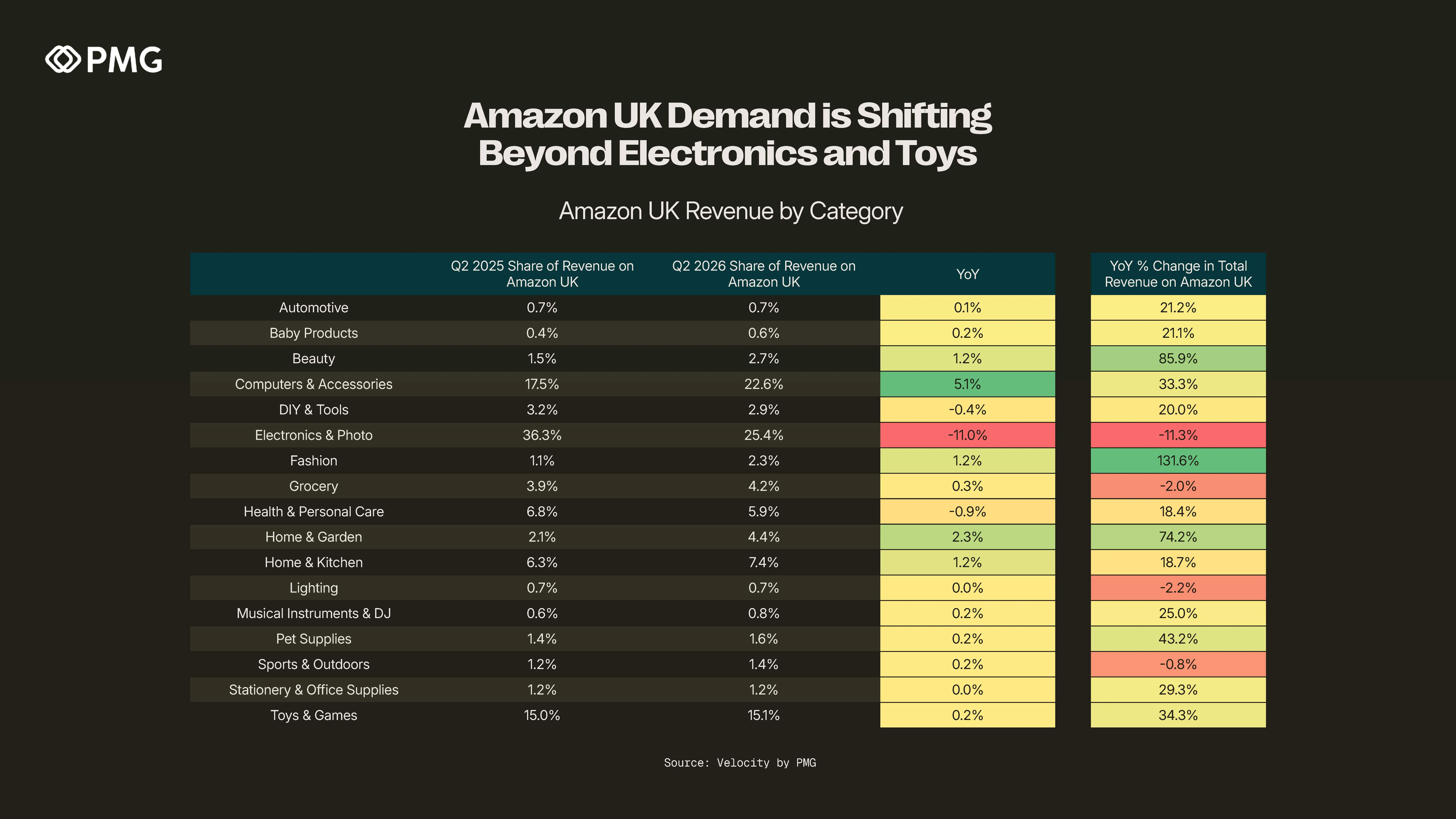
Fashion more than doubled its revenue, rising roughly 132% year on year and lifting its share from 1.1% to 2.3%.
Beauty sales grew about 86% year on year, nearly doubling the category’s share of Amazon UK revenue from 1.5% to 2.7%.
Home & Garden revenue rose about 74% year on year, with its share increasing from 2.1% to 4.4%.
The same dynamic defined Prime Day 2026. Grocery gained 4.1 points of unit share, Beauty gained 3.5 points and Fashion gained 2.2 points. Meanwhile, Home & Kitchen lost 3.6 points, Stationery & Office Supplies lost 2.7 points, and Toys & Games and Computers & Accessories each lost 1.6 points. Taken together, the shift towards frequently purchased, everyday categories appears to be a longer-term marketplace change rather than a temporary quirk.
This shift should reframe Prime Big Deal Days planning for many brands selling on Amazon UK. Although they still account for relatively small shares of site revenue, growing categories such as Beauty, Fashion and Pet Supplies present an opportunity for relevant brands that may have largely sat out previous sale events. Strong assortment, availability and merchandising will remain critical to successful execution.
Big-Ticket Spending Remains Restrained Despite the Prime Day ASP Spike
One important signal for Prime Big Deal Days is whether UK shoppers have been willing to spend more in 2026. In bigger-ticket categories, Amazon-only events such as Prime Day have not produced spending increases far beyond those seen during broader seasonal events like Easter.
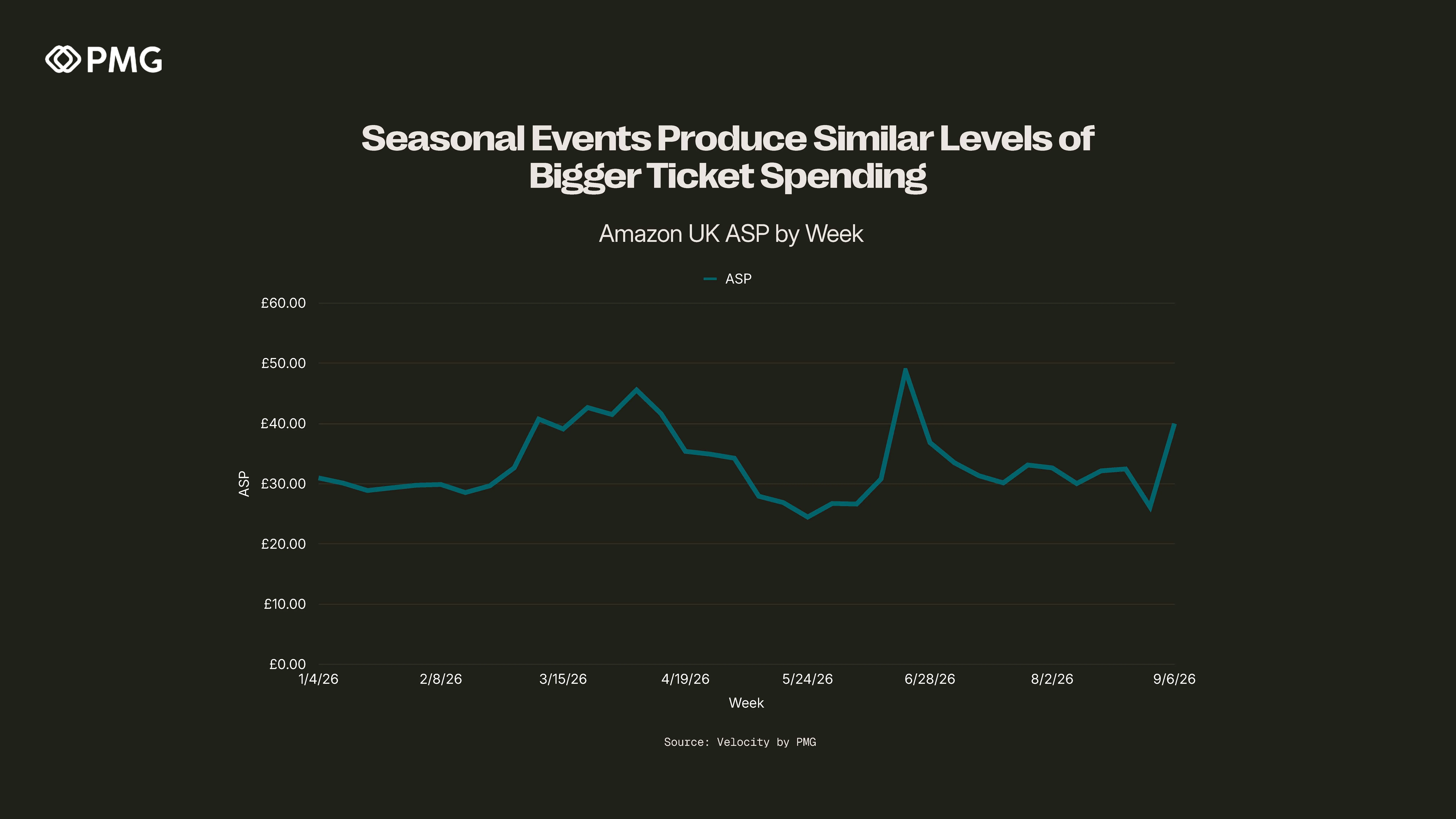
Tracking Amazon UK's site-wide ASP across 2026 reveals two clear but unequal seasonal lifts.
The Easter run-up produced a large, weeks-long ASP lift. ASP climbed from the high £20s in February to roughly £40–£45 from Easter week through mid-April, peaking at £45.60.
Prime Day produced a sharp but fleeting spike. Weekly ASP jumped to nearly £49 during the July event before falling markedly in the following weeks.
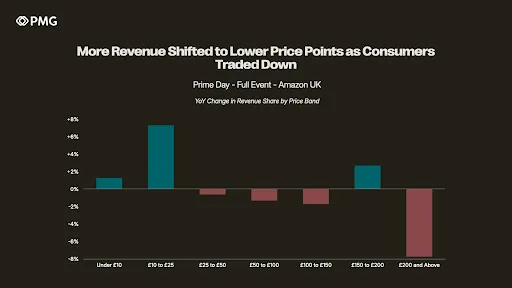
Although ASP during Prime Day week edged above the Easter peak, the small gap suggests that shoppers remained reluctant to commit to bigger-ticket purchases during the sale event. It also suggests that deals on those products may not have been attractive enough. Revenue shifted towards the bottom of the price ladder. Items priced from £10 to £25 gained 7.3 points of revenue share year on year, while products priced at £200 or more lost 7.7 points.
Meanwhile, average order values fell across the main big-ticket categories, including Sports & Outdoors by -8.9%, Electronics & Photo by -7.0% and Computers & Accessories by -2.9%. They rose in more affordable, everyday categories, including Fashion by 8.4%, Automotive by 7.6% and Pet Supplies by 4.3%.
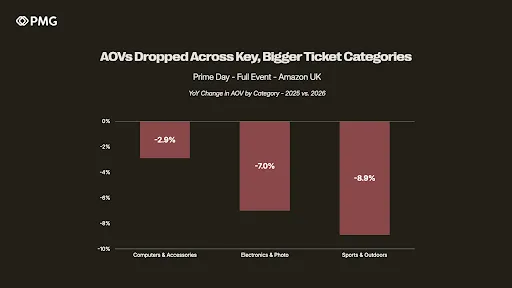
The implication for Prime Big Deal Days is that big-ticket categories are likely to face a tougher event than in 2025, as they did during Prime Day. In this price-conscious environment, brands will need an appropriately scoped promotional strategy and should use the event to gather lessons for the longer holiday period.
Three Priorities for UK Brands Heading into Prime Big Deal Days
Taken together, the Prime Day recap and the latest year-on-year and year-to-date data point to three priorities for the October event.
1. Capture Continued Growth in Everyday Categories
Beauty, Fashion, Home & Garden, and Pet Supplies are gaining share in the UK. Brands in these categories should treat Prime Big Deal Days as a genuine growth opportunity and ensure that their assortment, availability and merchandising are ready to capitalise on it.
2. Lead With Entry- and Mid-Price Products
Prime Day trends point the way. With revenue shifting decisively into the £10–£25 band and away from higher-priced tiers, more conversion opportunity lies at the lower end of the price ladder. Even in higher-ASP categories, brands with compelling affordable or mid-tier options should focus promotional activity on those products rather than newer or higher-margin alternatives to capture value-seeking shoppers.
3. Compete for Category Leadership
Prime Day 2026's fastest-growing brands included both global heavyweights, such as Adidas, ASUS and Xiaomi, and challenger labels, such as Dreo, Medicube and WeightWorld. On Amazon, incumbency guarantees nothing during peak periods. Every brand should assess retail readiness, advertising support and competitor-aware discounting product by product to maximise visibility against its closest rivals heading into the event.
After Prime Big Deal Days 2026 in the UK, PMG will report on category, price-band and ASP dynamics as the peak Christmas shopping season approaches.